.svg)


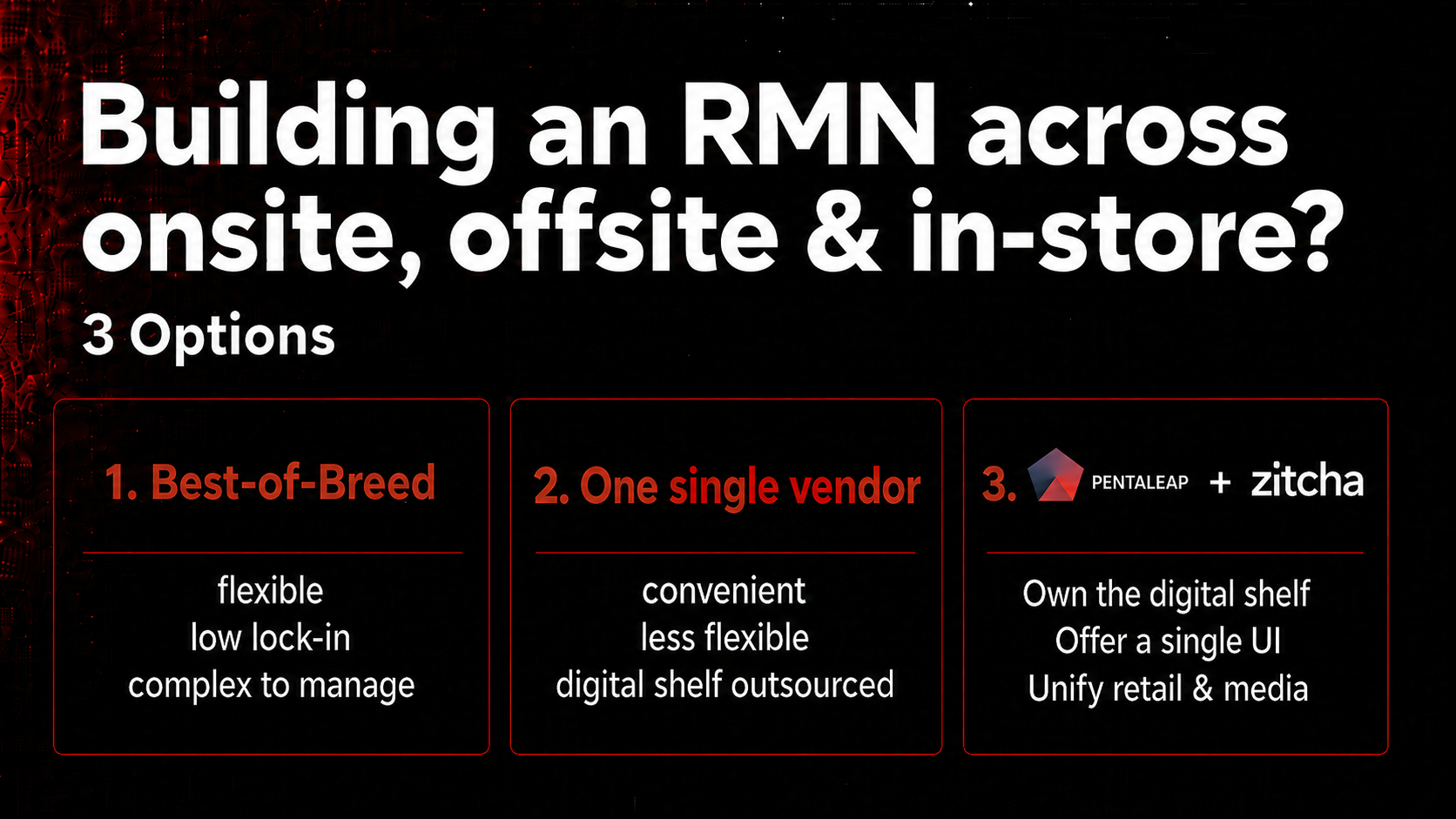
Building an RMN across onsite, offsite & in-store? 3 options: two with real tradeoffs, one middle path.
.png)
Most of you did not plan your way here. You started onsite, proved retail media worked, then expanded into offsite, in-store, and whatever came next. Each step asked something new of your stack, and your ad tech vendor could not keep up. So you added a tool. Then another. Your team ended up working across separate UIs and reconciling reports by hand. Self-service was no longer realistic.
You did not choose the tech sprawl; it accumulated.
So some of you started looking at the one thing that does it all. One vendor to make the mess disappear. It is a fair instinct, and it deserves an honest answer.
Three options: the first hard, the second risky, and the third, something smart retailers are now quietly pursuing.
1. Pick the best of each, and pay at the seams
The first option is best-of-breed, the deliberate version of what many of you arrived at by accident. You pick the strongest tool for each job: one vendor for sponsored products, another for offsite, a third for in-store, a fourth for measurement.
Costco is the most transparent example we have of this approach. This January its AVP of Retail Media, Mark Williamson, put the entire stack on stage at an NRF retail media event, the first time a US network revealed its full infrastructure in public (Kiri Masters, Retail Media Breakfast Club). Criteo on the onsite ad server, Moloco on display (MetaRouter), The Trade Desk, Google, Yahoo, Epsilon and StackAdapt offsite, Habu clean rooms for measurement. It is a serious architecture, and it is working. As Masters put it, Costco judged that “vendor partnerships would get them to market faster with proven technology, which mattered more than proprietary control.”
Then the person who built it said the hard part out loud. Publicly, Williamson admitted the composable path had become “It's taken longer, it's cost more money, and it's been way more complicated than it needs to be.” (MetaRouter).
Longer. Costlier. Harder than buying one box. Still, he believes it was the right call, and for Costco it was. But it is worth noting that even when chosen deliberately, and run in the open, it carries numerous costs: many vendors, many contracts, many moving parts, and a team whose time and energy go towards holding it all together. That is the tradeoff.
In short: Best-of-breed buys depth and pays in fragmentation.
2. Buy the all-in-one, and rent out your shelf
The second option is the one ease and instinct point to: the all-in-one. One login, one contract, easy to buy. Retail media moves fast, though, and you carry a standing risk that the vendor you pick cannot keep up. Some buyers worry about feature gaps too. That is the smaller problem.
To run the all-in-one, you hand your product grid to an ad vendor and let it rank your own shelf. But the grid, the digital shelf, is the business. Amazon knows this. Walmart knows this. Google has never once let an ad vendor decide what appears on its storefront. They control the whole experience, organic and paid.
Retail media is the only business that gives that away.
Skai has managed billions in Google and Meta budgets. It has never touched a single page Google renders. That boundary exists for a reason.
When you buy an all-in-one retail media platform, you hand your product grid to an ad vendor. It decides what your shoppers see, in what order, on your own site. The ad vendor's incentives and your shoppers' needs are not the same thing. They were never the same thing.
Everyone else owns their grid; only retail media gives it away.
3. All-in-one with a fully owned digital shelf
There is a way to keep both, gaining the ease of one tool and retaining complete ownership of your grid. The Home Depot found it first. Its operators and brands work in one orchestration tool, planning across onsite, offsite, and in-store from a single workspace. Underneath, Pentaleap brings sponsored products into the retailer's own ranking, scored by the same relevance logic that already orders their organic results. Their website, their decision, their relevance. Pentaleap supplies the infrastructure; they keep full control of the grid (MarketingDive).
One workspace on top. One owned shelf underneath.
Signing with two, closely integrated vendors means less dependency, less lock-in, and a grid that belongs to you. The ranking layer stays in the back, invisible. Your brands never see it. What they see is the single, all-in-one experience you wanted all along.
This is the model you get with Pentaleap and Zitcha. We joined forces under one belief: retail and media have to grow together. Pentaleap lives it by unifying the ranking across paid and organic, optimizing the aggregate output rather than either stream alone. Zitcha lives it offsite, acquiring traffic in a more sophisticated way that returns more than the media markup and drives real margin, the kind merchants care about. Two very different technologies, one philosophy, operating together (AdWeek).
The tech has finally caught up
Retail media is maturing, and the tech is finally maturing with it. The choices that defined the last few years were never really choices; they were compromises you made because nothing better existed. Best-of-breed has been the bandaid. Handing everything, including your own digital shelf, to a single ad tech company was the other extreme, and you have already seen why it fails.
Now, you have a better option: one infrastructure layer you control, and one UI for the teams who run the network, both operating under the same philosophy.
Two options force a tradeoff. The third resolves it.
Keep one UI. Own the shelf underneath it.
Then watch retail and media grow together.
Sources:
- Costco stack reveal (Kiri Masters, Forbes contributor / Retail Media Breakfast Club): https://www.retailmediabreakfastclub.com/p/costco-is-the-first-us-rmn-to-reveal-its-entire-tech-stack
- Mark Williamson on the composable path; Moloco display (MetaRouter recap of the Masters / Williamson / Flugstad conversation): https://www.metarouter.io/post/the-commerce-media-tech-stack-is-being-rebuilt-from-the-ground-up
- The Home Depot orchestration plus Pentaleap (Marketing Dive): https://www.marketingdive.com/news/home-depot-self-service-retail-media-advertising-week/729177/
- Pentaleap and Vantage partnership (The Home Depot Uses Pentaleap+ Vantage) https://www.einpresswire.com/article/795529973/pentaleap-and-vantage-partner-to-offer-retail-media-networks-a-unified-path-to-purchase
- Pentaleap and Zitcha partnership (All-in-one with a fully owned digital shelf) https://www.adweek.com/commerce/2-adtech-startups-team-up-to-solve-retail-medias-biggest-problem/
Stay Ahead with Retail Radar
Subscribe for cutting-edge insight into the latest retail media developments and trends
.png)

.webp)